A prospective customer usually doesn’t arrive on your website completely ready to buy.
They may be interested, but they’re still evaluating. They want to understand what you do, whether you’re credible, whether your solution applies to their situation, and ultimately whether they trust you enough to move forward.
Testimonials can help answer those questions, but only if buyers actually encounter the right customer stories at the right time.
This is where many businesses miss an opportunity. They collect testimonials, put them all on a dedicated page, and expect prospects to seek them out. But if you’re thinking strategically about how to use testimonials in your sales funnel, customer proof should appear throughout the buying journey.
Different stages create different questions. Your testimonials should help answer them.
Why Testimonials Belong Throughout The Sales Funnel
Think about the questions someone asks as they get closer to making a purchase.
At the beginning, they may be wondering:
Is this company legitimate?
Later, the question becomes:
Can they actually solve my specific problem?
Then:
Is this worth the investment?
And eventually:
Am I comfortable enough to say yes?
Those are very different concerns, which means showing the same generic testimonial repeatedly isn’t necessarily going to help.
A strong testimonial strategy considers what the buyer needs to believe at each stage and then introduces customer proof that supports that decision.
Instead of testimonials being a separate piece of marketing, they become part of the sales process itself.
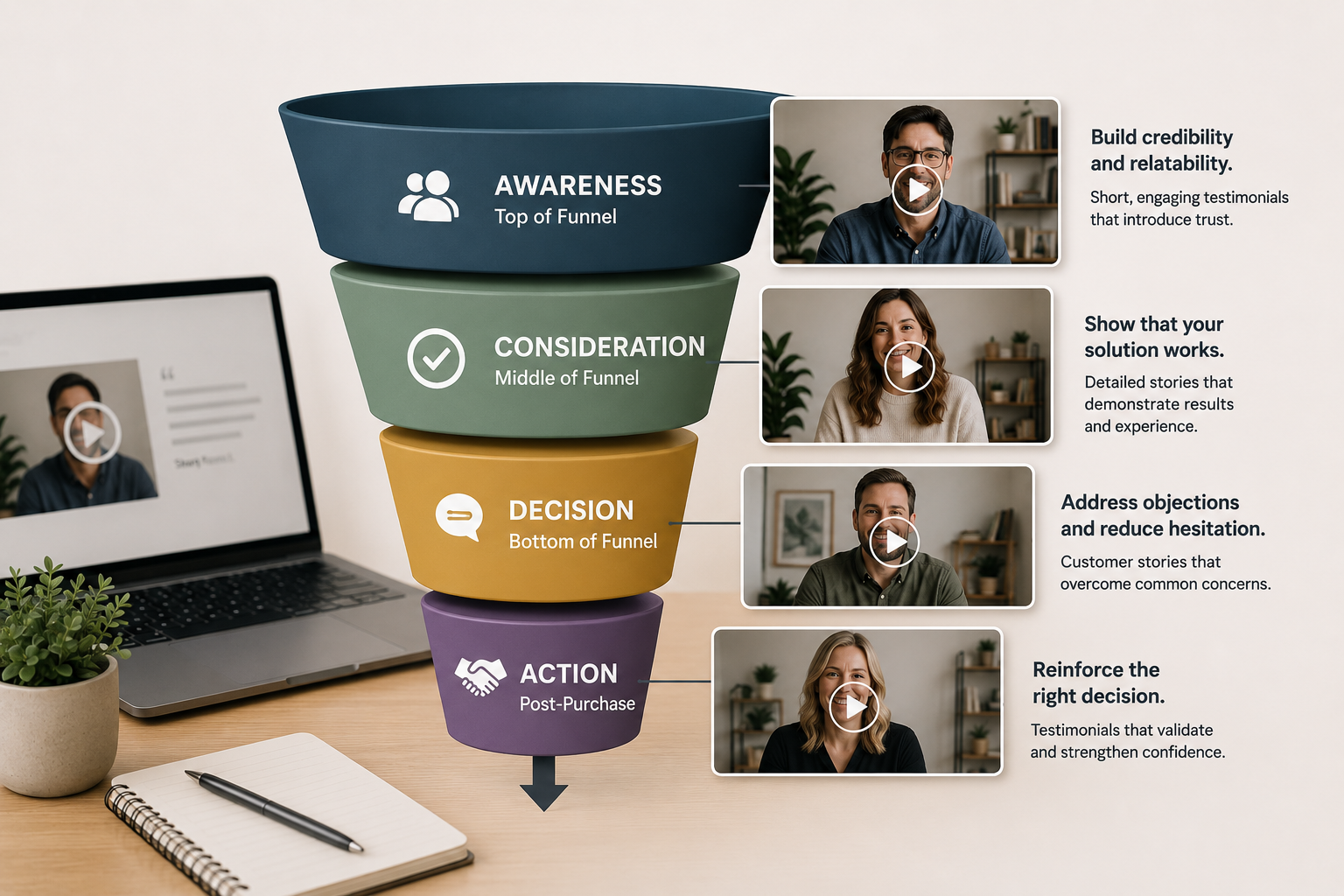
Top Of Funnel: Establish Credibility Quickly
At the top of your sales funnel, people may know very little about your business. They aren’t necessarily ready for a five-minute customer story, but they are beginning to form an impression of whether your company deserves their attention.
This is where short, highly relatable customer proof works well.
A strong clip on your homepage or social media can introduce a recognizable problem and show that your business has successfully helped someone solve it.
For example, instead of opening with a customer saying, “They’re incredible to work with,” you might use a clip where the customer explains the challenge that originally brought them to the company.
That immediately gives the prospective buyer context.
If they recognize themselves in the problem, they’re much more likely to keep listening.
Middle Of Funnel: Show Buyers That Your Solution Actually Works
Once someone understands what you do, their questions become more specific.
They’re no longer simply evaluating whether your company looks credible. They’re trying to understand whether your solution will actually work for them.
This is where more complete customer stories become valuable.
A middle-of-funnel testimonial might explain what the customer had tried previously, why those options weren’t working, what made them consider your solution, and what changed after they became a client.
The specificity matters.
A buyer comparing several providers doesn’t need another company telling them it delivers great service. They need evidence that helps them understand the experience and outcome.
A customer story can provide that evidence without forcing your sales copy to make every claim itself.
Use Testimonials On Service Pages To Support Your Claims
Service pages are one of the most natural places to use testimonials because this is where prospects are actively evaluating what you offer.
If you make an important claim on the page, consider whether you have a customer who can support it through their actual experience.
For example, if you say your process makes implementation easier, place a testimonial nearby from a customer who originally worried implementation would be difficult and then explains what actually happened.
If you promise responsive service, show someone describing how your team handled a difficult situation.
If you’re selling a measurable business outcome, use a customer who can speak specifically about the result they experienced.
The testimonial now has a purpose beyond simply saying something positive. It provides evidence for the message you’re already communicating.
Bottom Of Funnel: Address The Reasons People Hesitate
The closer someone gets to buying, the more important testimonials can become.
At this point, prospects often understand the offer. What remains are the concerns preventing them from acting.
Price is a common one.
So is timing.
They may worry about implementation, switching providers, whether they’ll actually use the service, or whether their situation is somehow different from the customers you’ve already helped.
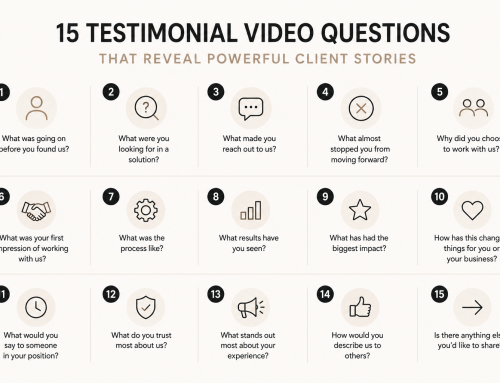
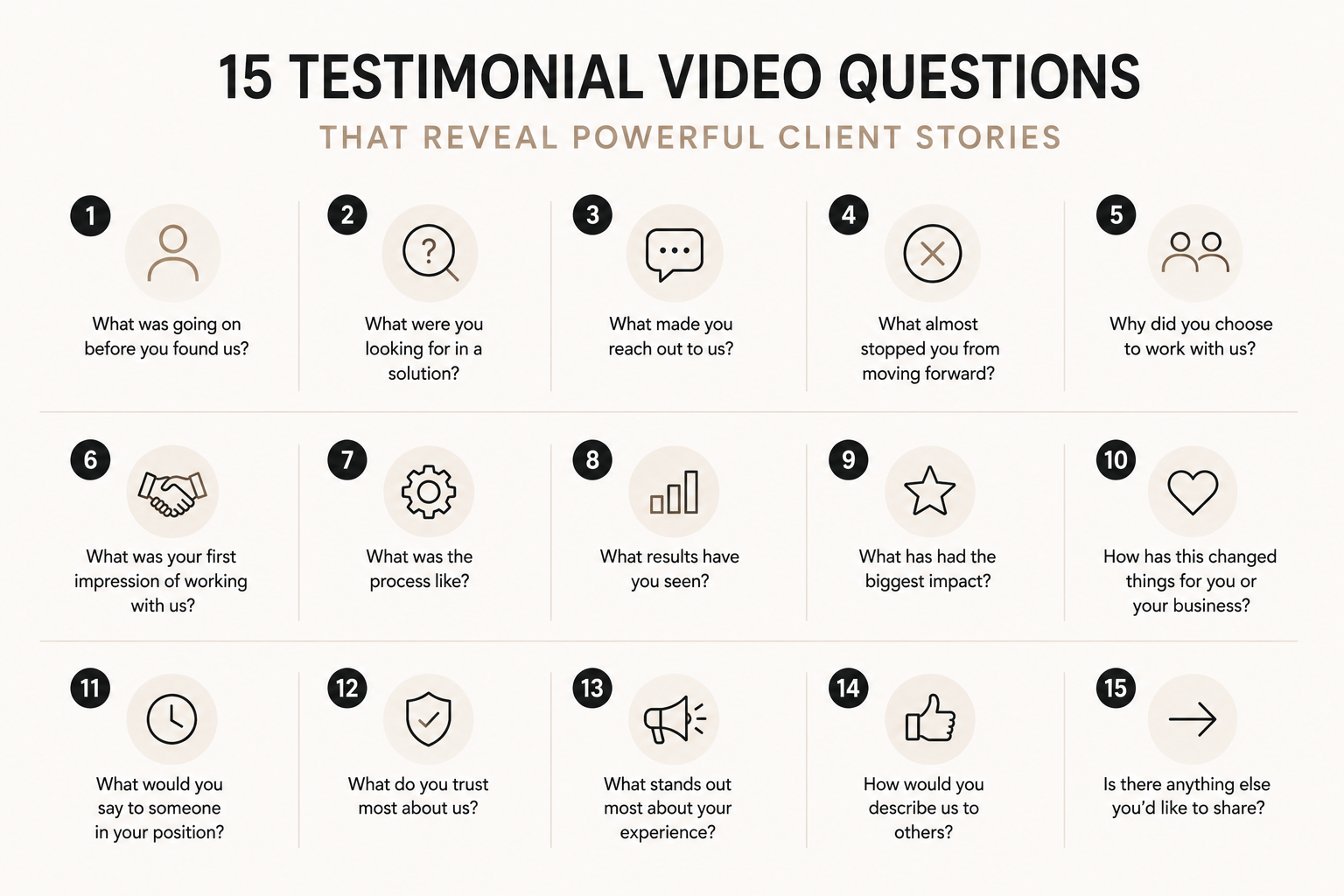
These are exactly the concerns we want to uncover when interviewing customers for testimonial videos.
When a customer says, “I almost didn’t do it because of the price,” that’s not necessarily something we want to cut from the video. If price is also a major objection for future buyers, that statement could be one of the most valuable parts of the story.
The customer can explain what made them move forward and, importantly, how they feel about that decision now.
That is much more persuasive than the company simply saying, “We’re worth the investment.”
Put Testimonial Videos Near Important Calls-To-Action
One of the easiest ways to improve how you’re using testimonials in your sales funnel is to look at your most important calls-to-action.
What is happening immediately before someone has to make a decision?
Maybe they’re about to:
- schedule a consultation
- request a proposal
- start a free trial
- submit an application
- purchase a program
- contact your sales team
These are natural moments of hesitation.
Placing a relevant testimonial near that decision can provide one final layer of reassurance.
The important word here is relevant.
If someone is deciding whether to schedule a consultation, a testimonial from a customer explaining how helpful that initial conversation was may be more useful than a completely unrelated story about a result they achieved six months later.
Match the proof to the decision.
Use Testimonials During The Sales Process, Not Just Before It
Testimonials shouldn’t stop working once a prospect enters your sales pipeline.
Sales teams often hear the same objections repeatedly. Those objections can help determine which customer stories you should capture and how those stories should be used.
Imagine a prospect has a sales call and says:
“We’ve tried something like this before and it didn’t work.”
Instead of relying entirely on the salesperson to overcome that concern, you could follow up with a customer story from someone who had a similar previous experience.
Now the prospect can hear directly from someone who understands their hesitation.
For B2B service businesses and other high-ticket offers, this can be especially useful because sales cycles are often longer and involve more consideration.
Customer stories give your sales team another way to build confidence between conversations.
Use Shorter Testimonial Clips In Follow-Up Emails
Not every testimonial needs to be a full customer story.
A longer remote interview can produce several short clips, each addressing a different question or objection.
One clip might focus on why the customer chose you. Another could address their initial hesitation. Another could explain a specific result.
Those clips can be extremely useful in sales follow-up.
Instead of sending every prospect the same two-minute testimonial, you can send the piece of the customer’s story that is most relevant to the conversation you just had.
This is one reason we approach testimonial interviews strategically from the beginning. We’re not only thinking about the final video. We’re thinking about all the places that customer’s story could help influence another buying decision.
Remote Testimonials Make Building A Proof Library Much Easier
If every customer story required a production crew, travel, studio time, and a full shoot day, building a large library of testimonial content would be difficult and expensive.
Remote testimonial production changes that.
Customers can participate from their own homes or offices, which removes a huge amount of friction from the process. It also creates a more familiar environment where people can relax and have an actual conversation instead of feeling like they’re performing on a commercial set.
That matters because a sales funnel doesn’t need one perfectly polished testimonial. It benefits from having multiple relevant customer stories that address different buyers, services, concerns, and stages of the decision process.
Remote production makes it much more realistic to build that kind of library while also preserving the natural quality that makes testimonial content believable in the first place.
One Testimonial Shouldn’t Have To Do Everything
Another mistake we see is expecting one great testimonial video to carry the entire burden of social proof.
Even a fantastic customer story won’t relate equally well to every prospect.
And if your business claims to have helped a large number of customers but only shows one person talking about the experience, that can create its own question: Where is everyone else?
You don’t need hundreds of testimonial videos, but buyers should be able to see a pattern of successful experiences.
Ideally, your testimonial library includes different customer types, challenges, objections, services, and outcomes. That gives you the flexibility to choose the strongest proof for the specific situation instead of showing everyone the same story.
Turn One Testimonial Interview Into Multiple Sales Assets
A strategically recorded customer interview shouldn’t only produce one video.
From one strong conversation, you may be able to create a primary customer story, several shorter clips, written quotes, social content, objection-focused videos, website content, and sales follow-up assets.
This is where testimonial production becomes much more valuable than simply “getting some reviews.”
You’re creating customer-driven content that can support your sales funnel from the first interaction through the final decision.
And because the message is coming from customers rather than your company, it provides a form of proof your own marketing can’t fully replicate.
How To Know Which Testimonials Your Sales Funnel Needs
Start by talking to the people closest to your customers.
Ask your sales team what objections they hear repeatedly. Look at questions prospects ask before booking. Pay attention to where people tend to disappear from the sales process.
Then compare those concerns against your existing testimonial library.
If prospects constantly worry about price but none of your customer stories discuss the investment, that’s a gap.
If implementation is a major concern but no customer explains what onboarding was actually like, that’s another gap.
Your testimonial strategy should be shaped by what prospective buyers need to know, not simply by which customers happen to volunteer to give you a testimonial.
That’s the difference between collecting testimonials and building a useful library of customer proof.
The Bottom Line
Learning how to use testimonials in your sales funnel starts with recognizing that different buyers need different kinds of reassurance at different stages.
Early in the funnel, testimonials can establish credibility and relatability. As buyers begin comparing solutions, customer stories can demonstrate results and explain the experience. Closer to the decision, testimonials can address hesitation and give prospects the confidence they need to move forward.
The strongest strategy isn’t to collect a few testimonials and place them all on one page.
It’s to build a library of genuine customer stories and intentionally use those stories wherever buyers are asking themselves, Should I trust this company enough to take the next step?
When testimonial content is created and placed with that question in mind, it stops being decoration on your website.
It becomes part of how you sell.